
A UC Davis Graduate Student Blog

Month: December 2018

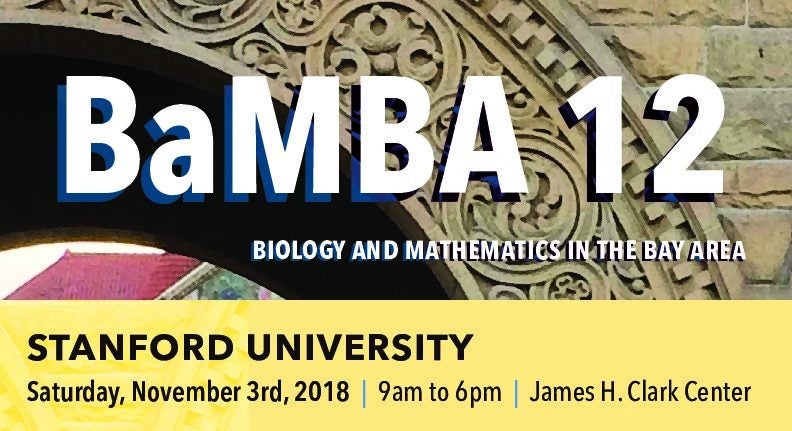
BaMBA 2018 poster

A Day of Biology and Mathematics in the Bay Area

Saturday, November 3rd marked the 12th Annual Biology and Mathematics in the Bay Area Conference (BaMBA). BaMBA has developed into a particularly unique conference where you can expect high-level research and opportunities for interdisciplinary collaboration. BaMBA 2018 was held at the incredible Clark Center at Stanford University.

This year’s BaMBA meeting featured five fantastic experts presenting topics ranging from statistical methods in machine learning to cell biology of the immune system: Dr. Lacramioara Bintu (Stanford University)  Dr. Sean Collins (UC Davis), Dr. Bin Yu (UC Berkeley), Dr. Dexter Hadley (UC San Francisco), and Dr. Andrew Fire (Stanford University).


I had a chance to speak with Dr. Massa Shoura of Stanford University, an organizer for BaMBA 2018, about what makes BaMBA unique. “What I like about it (sic) brings people together that usually don’t go to the same conferences.” Interdisciplinary conferences like BaMBA are important opportunities for attendees to gain new perspectives on their research.


“As we grow older scientifically we end up specializing and then we end up going to the same conferences and talking to the same people because we are trying to solve something very intricate, but it is nice every now and then for us to get out of our comfort zone and talk to people who we usually dont talk and we find out this person can look at the same problem from a different angle and we end up having diversity in the way we solve the problem.” – Dr. Shoura


Dr. Shoura also pointed out that, because BaMBA is funded from several sources such as UC Davis College of Biological Sciences, the registration fee is waived for all attendees, allowing a broad audience of students, professors, and professionals from across the Bay Area to attend.


Diana Sernas, a 4th year undergraduate student at UCSC (‘19), also thought the accessibility of BaMBA was an important element to the conference’s uniqueness and success. According to her, “[a]ny opportunity for undergraduates to present their work is just another [opportunity for] professional development.” She also presented a research poster about her work on analyzing the 3D architecture of the genome with Dr. Javier Arsuaga.


“Presenting a poster at a conference is a great way for undergraduates to meet other people passionate about science and to see where they might fit in. “We are having an opportunity to look like a scientist, to be a scientist, to present ourselves as scientists.” – Diana Sernas (‘19)


I was especially excited for Dr. Sean Collins’ presentation from the UC Davis Department of Molecular & Cellular Biology. Dr. Collins’ research focuses on understanding the complex regulation of neutrophil chemotaxis vital in the immune response. With the use of live-cell reporters, the Collins lab is able to quantitatively interrogate how neutrophils locate pathogens in complex, noisy environments.


Dr. Collins also pointed out the significant impact BaMBA’s accessibility and well-organized schedule has had on its success: “I think it’s a really great meeting. It’s a nice scale [and] easy to interact with people [even] with a full day…  I have also been enjoying breadth of the meeting with really different talks and posters. It’s very nice.”


In addition to the main speakers, sessions/panels, and poster sessions, Q&A sessions offered time to discuss the material and, in some cases, resulted in initiating collaborative projects. Dr. Bin Yu of UC Berkeley “really enjoyed [BaMBA]” and was especially happy “to talk to students and [make] professional connections with other speakers.”


I highly recommend attending BaMBA in the future! It is an unique, accessible conference and an incredible opportunity to meet other passionate scientists. Keep an eye out for information about future BaMBA conferences at the the website: bambameeting.org. You can expect to see me there at BaMBA 13!


Author: Keith Fraga

Editor: Sydney Wyatt

Mastering the art and science of good presentation design

Powerpoint presentation is one of the most effective ways to communicate our science. However, mastering the art of presentation can be a long and enduring journey. There are two parts of a good presentation. One is about speaking, and the other is the actual presentation itself. If you have a fear of public speaking, please check out our previous post on “combat the public speaking fear”.

This post focuses on the design components of a good presentation. Luckily for us, there are many fundamental principles that you can learn from this short-ish video to help you achieve that mastery. This video, suggested by Hongyang Hao from Dan Starr’s lab, features Stanford neurologist Susan McConnell. Susan McConnell is a world-respected scholar and science communicator with iBiology. She is a member of both National Academy of Sciences and the American Academy of Arts and Sciences, and she is also both an HHMI scholar and a Pew Scholar. The list goes on and on.

You may know some of the recommendations already from the video, especially, if you are a UC Davis BMCDB graduate student who went through our awesome rotation class. However, I’m sure there is much more new information that you can learn from this video. Also, it is just a good practice to systematically evaluate your presentation skills once a while, and make sure your presentations don’t have the pitfalls mentioned in the video.

Mentioning the rotation class made me remember my first presentation in that class. All I can say is “ughhhhh”. I’m so glad it is better now.  

Yulong

Want to see more awesome videos like this one? Make sure to check out iBiology and their videos on the importance of giving a good presentation and more tips on creating effective slides.


Suggested by Hongyan Hao

Edited by Anna Feitzinger, Keith Fraga

For any content suggestions or general recommendations, please email to UCDBioScope@gmail.com and put science 2.0 in the title.

Do Regulations on Genomic Data Inform or Mislead the Public?

Author: Emily Cartwright

Editor: Hongyan Hao


As sequencing costs drop and more companies develop genomic testing for everything from predicting hair color to the risk of disease susceptibility, the public has access to a wealth of personalized health information. At the same time, companies are faced with the decision of how much information to release to the public, only some of which is regulated. The Food and Drug Administration (FDA) has policies on what kinds of information that companies such as 23andMe and Ancestry.com can release to the public, but there are many enterprises that are not clinically certified and utilize genomic data to conduct health studies (1). How to regulate and disseminate findings from these companies, especially smaller scale studies that may not be clinically certified, is an unresolved issue.

Many of the current FDA regulations for companies like 23andMe are disease specific. Regulations released in 2017 allowed 23andMe to report on variants associated with 10 diseases or conditions (2) and in 2018, allowed the release of information on three BRCA1/BRCA2 variants to consumers who submitted for genetic testing (3). These specific BRCA1/2 variants are known to be associated with an increased risk of developing cancer but there are over 1,000 identified BRCA mutations (3). While these regulations limit the amount of information that consumers are provided, they also circumvent the current issue of how to relay health information to patients in a truthful and informative way; where it is made clear that the results of genetic testing indicate the known risk of developing a certain condition.

It is crucial that companies emphasize that not having a genetic marker associated with a disease or condition does not mean that the individual will not develop the condition. Current regulations from the FDA seek to limit what information can be released to the public but do not address how large companies can best convey health information to consumers. There are also gaps in the ability of agencies like the FDA to regulate all health information gleaned from genomic data, as many small companies do not fall under their regulatory jurisdiction (1).

Recently, the National Academies of Sciences, Engineering, and Medicine (NASEM) released a report (4) encouraging researchers to relate findings from biological data analysis back to people whose samples were used in the studies. The report is intended to increase the flow of information from scientists to the public, but a central issue still involves the question of how to convey information in a way that is both meaningful and accurate, in terms of whether or not a finding has medical significance

Genetic variants may indicate risk of disease susceptibility, but this is not necessarily causal and relaying such information to the public can be tricky (1). Researchers are also faced with an increased cost of funding for these studies because determining how to relay information to the public and executing this can result in additional expense (1). The NASEM recommended that researchers should plan out what information they will release from their studies prior to starting them, which may also help the researchers to plan out the added cost of relaying this information (1,4).

The flow of information from researchers to consumers is important but the fact that many studies are carried out by third parties also lies at the forefront of this issue. Companies that do not do the initial genomic sequencing and that may not have the clinical or scientific background to make the diagnoses they relay to consumers may give misinformation (1). The New York Times reported on a case where a doctor had sent his genomic data to a third party, Promethease, and was told that he had a variant known to be associated with Lynch syndrome, a disease that predisposes individuals to cancer early in life (5). The variant was associated with the disease but was not known to cause it, and more importantly, after sending out for genetic testing at a medical diagnostic firm, the doctor received results confirming that he did not actually have the mutation (5). The discrepancy in results brings up the issue of who should be allowed to handle genomic data and how should companies that do not fall under the umbrella of FDA regulations be treated (1). Right now, there may not be a good way to handle third party testing centers that have not been clinically certified, but consumers should be aware of the potential misinformation in results from these companies.

While there are still grey areas concerning the regulation of findings from studies that utilize genomic information, there is an effort to move towards defining what should be released and how. As researchers move towards utilizing this type of data for health and genetic studies, organizations such as NASEM are becoming more critical to help define what and how this information is treated and disseminated. There are many third-party companies that will not fall under guidelines set out by the NASEM but there is still a need to regulate how and what these companies can do with genomic data as well as how their information is released to the public (1). This can come from both sides, in conveying more accurate and meaningful data to consumers and in being more direct about the difference between association and causality in the relationship of variants to disease or condition.


Works Cited:

  1. Couzin-Frankel, J. (2018). If you give your DNA and tissues to science, should you get a peek at what they might contain? Science (New York, N.Y.). http://doi.org/10.1126/science.aau7323
  2. Administration, U. F. A. D. (2017). FDA allows marketing of first direct-to-consumer tests that provide genetic risk information for certain conditions.
  3. Administration, U. F. A. D. (2017). FDA authorizes, with special controls, direct-to-consumer test that reports three mutations in the BRCA breast cancer genes.
  4. National Academies of Sciences, Engineering, and Medicine, Health and Medicine Division, Board on Health Sciences Policy, Committee on the Return of Individual-Specific Research Results Generated in Research Laboratories, Downey, A. S., Busta, E. R., et al. (2018). Returning Individual Research Results to Participants: Guidance for a New Research Paradigm. http://doi.org/10.17226/25094
  5. Kolata, G. (2018, July 2). The Online Gene Test Finds a Dangerous Mutation. It May Well Be Wrong. The New York Times. Retreived from https://www.nytimes.com/2018/07/02/health/gene-testing-disease-nyt.html


Additional Links:

Spit is a podcast put out by 23andMe and iHeartRadio that features celebrity dialogue, highlighting some of the social issues surrounding genomic data.

On privacy issues surrounding genomic data: https://www.theverge.com/2018/8/1/17638680/genetic-data-privacy-consumer-rights-guidelines-23andme-ancestry

And in the news: https://www.nytimes.com/2018/10/18/opinion/sunday/dna-elizabeth-warren.html

More on the role of NASEM in regulating the release of information from genomic studies: https://www.biospace.com/article/national-academies-report-provide-patients-with-clinical-study-results/

Powered by WordPress & Theme by Anders Norén